How to Make B2B Positioning AI Readable
July 12, 2026
/
8 min read
(Coming soon)



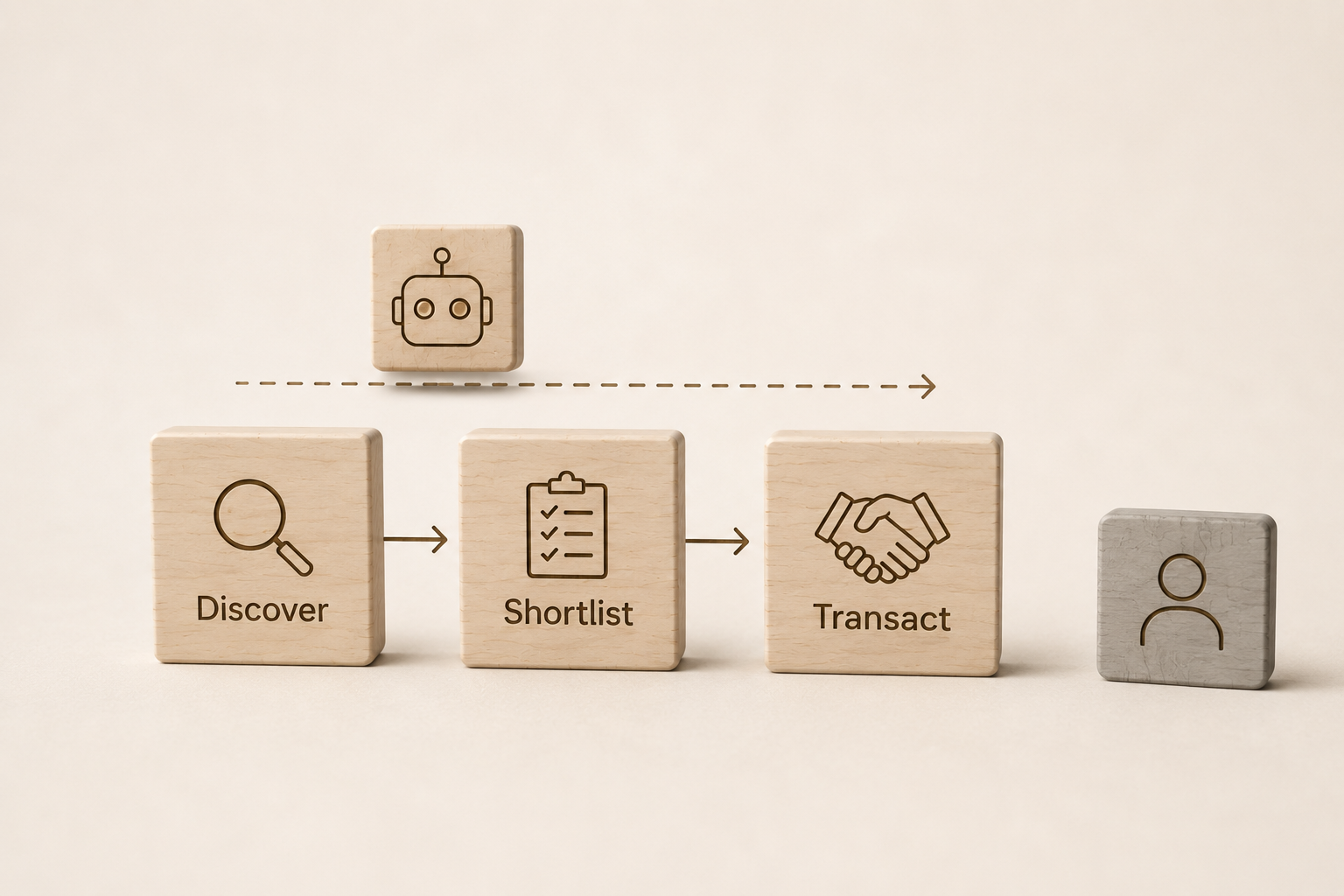
... or how to win the Agentic shelf when the buyer is a bot.
This week I asked Claude how the market positions a US-based French SaaS company (strong product, careful messaging) on AI agents. What came back wasn't the positioning they had written. It was a different company, reassembled from whatever the model could find: a category they hadn't chosen, a claim they wouldn't have led with. The founder had a clear idea of what he stood for. The machine had a different one, and the machine's version is the one their buyers' agents meet first. That gap, between the positioning you intend and the one a model returns, isn't a rendering glitch. It is your positioning now.
If you didn't author the claims LLMs extracted, you didn't lose the deal, you were never a candidate.
So if you're asking how to make B2B positioning AI readable, the answer is not better persuasion but better extraction: make your category, claim, and proof separable, declarative, and quotable, and name a category an incumbent doesn't already own so the agent can resolve and place you correctly. For B2B product marketers, especially European SaaS teams entering the US market, that shift matters because AI agents now act as the first evaluators in buying, filtering vendors on machine-legible claims before a human evaluator opens your site. If you didn't author the claims it extracted, you didn't lose the deal, you were never a candidate.
The consensus says the answer is generative engine optimization: add schema, write FAQs, get cited, make your content answer-engine friendly. That advice treats the agent as a better search engine that ranks your page. It doesn't. An agentic buyer doesn't rank pages. It resolves an intent into a category and a set of criteria, then populates candidates that fit. GEO tactics improve your odds of being retrieved. They do nothing about whether you're legible, whether the agent can place you in a category, attach proof to your claims, and pass you to the next step without inferring the parts you left blank.
What follows is about agentic commerce, AI-readable positioning, and the difference between messaging built for human persuasion versus agent evaluation, including why uncontested category names, governance trust, and extractable claims now shape whether your company makes the shortlist at all.
Agentic commerce is software completing the discovery-to-checkout path on a buyer's behalf, without a human in the loop for each step. This is no longer a forecast. On June 17, 2026, Shopify shipped its Spring '26 Edition: a Catalog API that turns products from millions of merchants into structured, queryable data, and the Universal Commerce Protocol, co-developed with Google, that lets any agent discover, negotiate, and transact against any merchant. Catalog access takes an API key and no approval. The infrastructure for agent-mediated buying is now self-serve.
The agent is the first reader. The human is the second.

B2B is the same mechanism wearing a longer sales cycle. The buying committee already includes systems such as ChatGPT, Perplexity, Gemini, analyst-trained models, that scope vendors, draft shortlists, and frame the comparison before procurement schedules a call. The agent is the first reader. The human is the second.
Here is the part the GEO playbook misses in my opinon. An extraction step keeps the structured residue of your positioning and discards the rest. Human-tuned messaging optimizes for narrative arc, emotional resonance, and a confident hero line, exactly the material an agent throws away. What survives is mechanical: what are you, what do you replace, what's the proof, what's your governance posture. Write that residue yourself or the agent infers it, usually from third-party coverage and your competitor's framing.
Because persuasion and extraction reward opposite things. A human reader rewards a story that builds. An agent rewards a claim that stands alone. The sentence "We help ambitious teams unlock their potential" is a complete failure to an extractor: no category, no referent, no proof, nothing to file. The sentence "Repackaged is a positioning advisory for European B2B SaaS companies entering the US" is legible — an entity, a category, a buyer, a scope, liftable verbatim into a shortlist.

The deeper failure is categorical. If your positioning doesn't name a category the agent can resolve, the agent files you under one it already knows, probably your incumbent's. Now you compete inside the incumbent's frame, on the incumbent's criteria, as the less-known alternative. You didn't get compared and lose. You got mis-filed and never competed.
This is Richard Rumelt's diagnosis, not a tactics gap. The problem isn't that your copy is under-optimized. It's that your category is unnamed, so the machine names it for you. Optimizing the copy harder makes an unowned category more discoverable, which helps the incumbent who owns it.
Position for extraction, not persuasion. Make the category, the claim, and the proof separable, declarative, and quotable, and name a category an incumbent doesn't already own.
A French adtech company I advised had been pitching frontally against the two dominant US ad-monetization platforms. To an agent resolving "ad monetization for publishers," that pitch returns the incumbents and files the challenger as a worse-known substitute, the mis-filing failure, exactly. The reframe wasn't louder copy. It was a category the incumbents don't hold: a publisher operating system for professional media companies. Same product, different slot. The agent now had a distinct place to put it, with no incumbent already sitting there. The category name is the unit of machine legibility. Owning an uncontested one is the difference between being a candidate and being a footnote to a competitor.
This is Michael Porter underneath: a distinct position is built on a distinct activity system, not a louder claim about the same one. AI Agents make that discipline mechanical. They can only place you where your claims say you belong, and they reward the framing that is cleanest and earliest, because that's the one they repeat.
This naming work is product marketing's core job in the agent era. For a European company landing in the US, it's also the highest-leverage one: a category that resolves cleanly in the US market is what lets the machine place you on its terms instead of filing you as a foreign version of a domestic incumbent.
CATEGORY: [the named market slot you own — not the incumbent's]
ENTITY: [your company, named consistently everywhere]
BUYER: [who it's for, specifically]
REPLACES: [the status quo or tool you displace]
CLAIM: [one capability, stated as fact]
PROOF: [a named example, metric, or verifiable referent]
GOVERNANCE: [trust posture as a checkable attribute, not an adjective]
These same fields should also be reflected in Schema.org markup so AI systems can identify the company type and services consistently.
Each line stands without the others. That's the test: if an answer engine lifts one line out of context, does it still say something true and placeable? If not, it's persuasion, and the agent discards it.
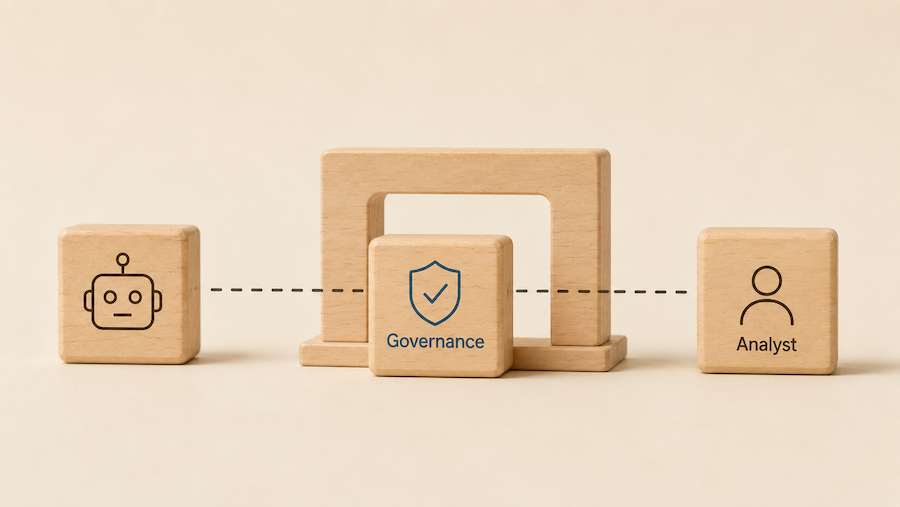
Because trust is becoming machine-checkable, and machine-checkable trust becomes a filter. In December 2025 Forrester named the agent control plane the third functional plane of enterprise agentic architecture, alongside the build plane and the orchestration plane — the layer that keeps autonomous behavior aligned with policy, identity, and risk tolerance. Its 2026 landscape research formalizes governance, portable agent identity, and cross-plane policy as evaluated capabilities.
The consequence for positioning is direct. "Trustworthy" was a brand adjective a human skimmed past. In an agent-mediated evaluation it becomes an attribute the system checks: how does your product handle identity, permissions, auditability, and policy when an agent, not a person, is the operator? A B2B data company I know and advise well carries this advantage and under-states it. Its most differentiated asset isn't coverage or price; it's being agent-native at the orchestration layer, built so agents can call it cleanly and safely. That is governance expressed as capability. In the agent era it's not a compliance footnote. It's the reason you clear the filter.
This is where Analyst Relations changes shape rather than disappears. The evaluator used to also be a Forrester or Gartner analyst you briefed before a Wave or a Magic Quadrant. It still is and now it's also the analyst-trained model and the control-plane checklist running the first pass. Briefing the new evaluator is AR work: feeding it accurate, structured, governance-grade claims so the model that shortlists you repeats the right ones. For a European entrant, this is also how you close the credibility gap a US committee holds against an unfamiliar name, the proof an analyst would have vouched for, now made legible to the machine that pre-screens for them.
Short, and closing on a visible clock. On June 15, 2026, Salesforce signed to acquire Fin, formerly Intercom, for roughly $3.6 billion, folding a customer-facing AI agent that resolves around three-quarters of support volume autonomously into Agentforce. Shopify made agentic infrastructure self-serve. Read together, the move is to me unmistakable: incumbents are buying the components and the category language of "agent-ready" before challengers finish describing the problem.
The first mover who defines clean, extractable category language gets repeated. The second mover gets compared.
This is the window. Once an incumbent's framing becomes the default the agents repeat, challengers inherit a losing comparison by default, filed under the leader's category, judged on the leader's criteria. The first mover who defines clean, extractable category language gets repeated. The second mover gets compared.
You don't lose loudly. You lose silently, in a context you can't observe. The rejection happens at the agent's pre-filter, before any human sees you, so pipeline thins with no visible cause, no lost deal to review, no objection to answer, just an absence. For a European challenger entering the US, this compounds a penalty you already carry. You read as foreign to the human committee. Now you're also illegible to the machine that pre-filters for it. Two filters, both failing quietly, before the conversation you've built your whole go-to-market to win.
The agentic shelf is the set of candidates an agent shortlists before a human evaluates. Positioning's first job is no longer to persuade a person. It's to be legible to the machine that decides whether the person ever meets you. That's the convergence underneath all of this: Product Marketing and Analyst Relations are merging into one function, making a company legible and credible to buying committees that now include AI alongside humans. The analyst-trained model and the answer engine are the new evaluator, and they read structured claims, not stories.
The incumbents are stocking the shelf with their own category language while challengers are still writing hero lines. The framing set this quarter is the framing models will repeat next year. Define your category in terms an agent can lift, or be filed under someone who did.
Agentic commerce — software that completes discovery, evaluation, and transaction on a buyer's behalf, without a human approving each step.
Agent-ready positioning — positioning expressed as discrete, verifiable, quotable claims tied to a named category, so an AI system can extract machine-readable claims and repeat them accurately.
Machine legibility — the degree to which an AI evaluator can resolve what a company is, what category it belongs to, and what proof supports its claims, from the structured data and other structured information available in a form AI systems can parse.
Agent control plane — the governance layer (Forrester, 2025) that keeps autonomous agent behavior aligned with an organization's policy, identity, and risk tolerance; in B2B buying, the source of agent-era trust criteria.
How do I optimize for AI shopping agents? Make your positioning extractable, not just discoverable. Name a category the agent can resolve to an uncontested slot, state each claim as a standalone sentence, attach a named proof point to it, and express your governance posture as a checkable attribute. Traditional SEO still helps humans navigate and trust the page, but ai shopping agent optimization depends more on structured data that machines can parse and compare reliably. When optimizing for AI, implement schema markup as complete product schema in json ld, and include core product details such as name, description, SKU, price, and availability. If that data is incomplete, agents may skip the item, because they evaluate product attributes more heavily than marketing copy. Customer feedback also matters because customer reviews are a primary input for AI recommendation models, and descriptive, high-volume reviews with specific use cases build more trust than star ratings alone.
What is agentic commerce? Software completing the path from discovery to checkout on a buyer's behalf without a human in each step. Shopify's Spring '26 Universal Commerce Protocol and Catalog API, launched June 17, 2026, made the infrastructure self-serve for any developer.
How do I make B2B positioning AI-readable? Separate category, claim, and proof so each stands alone and quotable; name a category an incumbent doesn't own; and keep your entity name and category language consistent everywhere a model might read them.
Repackaged helps European B2B SaaS companies become legible and credible to US buying committees, the humans and the machines now sitting on them. This piece sits in Your New Buyer Is Also a Machine, our line of work on what changes when the systems screening you include AI alongside the analysts. If you want to see what the agents, analysts, and US buyers actually return when they're asked about your category today, start here: our Evaluator Visibility Report gives you screenshot-ready proof of whether you're on the US shortlist or invisible, before you spend a dollar to enter or expand, with the fee credited toward whatever you do next.

Contact us to learn more about how we can help you accelerate your business success.

