How Do I Get My Company Into a Forrester Landscape?
July 15, 2026
/
9 min read
(Coming soon)




Or How a European Challenger Earns a Spot?
The short answer: If you're asking "How do I get my company into a Forrester Landscape?", you do it by making your company legible to the analyst before the research cycle opens: a category-aligned data sheet, referenceable customers in the target geography, and a briefing cadence that starts at least 90 days out. Inclusion is earned through a repeatable analyst relations motion — not a budget line, not a sponsorship, and not luck.
A French cross-channel marketing vendor we work with was named in Forrester's Cross-Channel Marketing Hubs Landscape, Q2 2026 this May — a category defined and dominated by US incumbents, in a report that typically features only 30–40 vendors worldwide.
They didn't buy their way in. Forrester doesn't sell inclusion, and no reputable analyst firm does. They earned it with a specific and repeatable sequence of AR work. This post is for European challenger vendors — especially teams scaling into North America — that need credible category visibility, want to become legible enough for North American analyst coverage, and need a practical path into new markets without false repositioning or wasted effort.
The focus here is Landscape inclusion — not a general AR primer, and not a Wave campaign. You'll see what Forrester Landscapes are, why they often matter more for challengers than Waves, what analysts look for when deciding inclusion, the 90-day motion that improves your odds, the mistakes that keep European vendors invisible, and a readiness check you can run before the next research window opens.
Because for a challenger, the Landscape is where you become real.
A Forrester Landscape describes the business value of a technology category and identifies the vendors that credibly compete in it. It's the document a B2C or B2B buying committee pulls when they build their longlist — before any Wave, before any demo. If you're not in it, you don't lose the evaluation. You never enter it.
The Wave is a different game entirely. Waves carry inclusion criteria — revenue thresholds, customer counts, geographic mix — that most European challengers fail by design. Chasing a Wave you can't qualify for forces false repositioning: you contort the product story to fit criteria written for incumbents. We call this the Forrester Wave trap, and it kills more European positioning than any competitor does.
The Landscape has a lower bar and a higher payoff for a challenger:
For a Series A–C European vendor entering North America, one Landscape inclusion does more for credibility than a year of paid demand gen.
Landscapes are built from vendor-supplied information, analyst knowledge of the market, and evidence the analyst can verify. (A Wave is a more formal vendor evaluation, with structured criteria and customer references — a different, later game for a challenger.) For a Landscape, the analyst is answering three questions about you:
Do you actually belong in this category? Not "could you stretch to fit it" — do the core use cases of the category describe what your customers buy you for? Forrester defines Landscape categories by explicit core and extended use cases. Your inputs must map to their taxonomy, in their vocabulary, not your website's.
Are you commercially real in the geography the report covers? For a North America-weighted category, that means named or referenceable US customers, US revenue, and a US go-to-market presence — not a "we're expanding to the US" slide.
Can they verify it? Analysts triangulate. Your claims get checked against your public footprint: website, case studies, customer reviews, press, and increasingly what AI-assisted research surfaces about you. If your public story contradicts your briefing, the briefing loses.
The inputs that move the decision, in rough order of weight:
The client's inclusion in the Q2 2026 report wasn't triggered in Q2 2026. The work started the previous autumn. Here is the shape of the motion — three phases, each defined by the outcome it must produce:
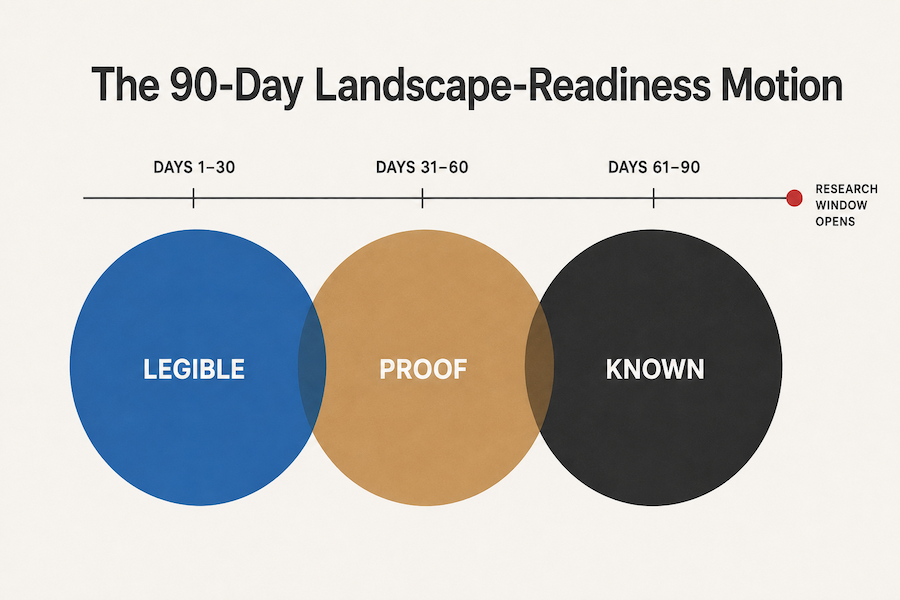
The outcome of this phase: an analyst who has never met you could read your materials and place you in the right category, in their vocabulary, without translation work. Analysts at major analyst firms track entire markets — dozens of vendors, evolving use cases, shifting buyer expectations. They don't decode individual vendors. If Forrester calls it "cross-channel marketing hubs" and you call yourself an "omnichannel engagement platform," you've created translation work the analyst won't do. Most European vendors fail here before any briefing happens.
The outcome of this phase: verifiable customer evidence in the geography the report covers — the kind of evidence analysts lean on because buyers use their research for vendor due diligence. European proof doesn't transfer: a strong EU customer base reads as "not commercially real here" to a North America-weighted report. What counts is referenceable US accounts and a public footprint (case studies, reviews, press) that tells the same story your analyst-facing materials tell. Analysts triangulate; inconsistency reads as risk.
The outcome of this phase: you are a known quantity before the research window opens. Vendor briefings are free, open to non-clients, and the single highest-leverage action in any AR program a challenger can run — yet most European vendors either never request one or burn it by pitching. A briefing that teaches the analyst something about where the market is going gets remembered; a sales deck gets forgotten. Then the cadence continues, independent of research cycles — because inclusion decisions reward the vendor who was already present, not the one who surfaced when the questionnaire circulated.
90 days is the minimum runway from first briefing to landscape consideration. Vendors who start when the research questionnaire lands have already missed the cycle.
The vendor — a French customer-engagement platform scaling into North America — came to us with a familiar profile: strong European customer base, real product differentiation, and near-zero analyst visibility in the US. To the analyst who owned their category, they were, at best, a name on a long tail.
Three things changed between autumn 2025 and the May 2026 publication:
They stopped describing themselves in their own language. Their positioning was rebuilt to map cleanly onto the category's use-case structure — the same words the analyst uses, on the homepage, in the data sheet, in the briefing deck. Positioning precedes execution; this was the execution's foundation for better market visibility.
They converted European proof into North American proof. US-market customer evidence was prioritized, packaged, and made referenceable to the analyst — proof the analyst could verify in the geography the report covers.
They briefed early and briefed again. The first analyst briefing happened months before the research cycle opened. By the time the Landscape questionnaire circulated, the analyst already knew who they were, what category they belonged in, and which customers could vouch for them.
Result: named in the Q2 2026 report, alongside the US incumbents their prospects default to. The sales team now opens North American conversations from inside the buyer's evaluation map instead of outside it.
Five failure patterns I have commonly saw, all fixable:
Score yourself: one point per "yes."
Category fit
Geographic proof
Analyst relationship
Verification layer
9–12: You're landscape-ready — timing and cadence are the remaining variables. 5–8: The raw material exists; the legibility work doesn't. This is the 90-day zone. 0–4: You're invisible by design, not by fate. Start with the category-fit block and re-score each quarter.
Can you pay Forrester to be included in a Landscape? No. Forrester Landscape inclusion is not for sale, and being a Forrester client does not determine inclusion. Inclusion follows from category fit, verifiable market presence, and the analyst's knowledge of your company — which is why the briefing motion matters.
How long does it take to get into a Forrester Landscape? Plan for a minimum of 90 days of groundwork before the research cycle opens, and realistically one full publication cycle — 12–24 months for most Landscapes, though timelines vary by category and publication cadence. Vendors who first engage when the questionnaire circulates have usually missed that edition.
What's the difference between a Forrester Landscape and a Forrester Wave? A Landscape maps the vendors in a category and its use cases. A Wave is a formal vendor evaluation: a shortlist scored against weighted criteria with inclusion thresholds (revenue, customer count, geography), placing vendors in tiers from Leaders to Challengers, presented in the Forrester Wave graphic alongside detailed vendor profiles. For challengers, the Landscape is the realistic near-term target and the prerequisite relationship-builder for a future Wave.
Do analysts brief with vendors who aren't clients? Yes. Forrester, Gartner, and IDC all take vendor briefings from non-clients, free of charge. Briefings are the core mechanism by which unknown vendors become known — and the most underused AR asset among European challengers.
If you scored below 9 — or don't know which report you should be in — that's exactly what a 30-minute AR readiness assessment answers. We'll tell you which Landscape covers your category, what the analyst will and won't be able to verify about you today, and whether the next cycle is realistic.
Book your AR readiness assessment →


Contact us to learn more about how we can help you accelerate your business success.

