Should PMM and AR Sit on One Team?



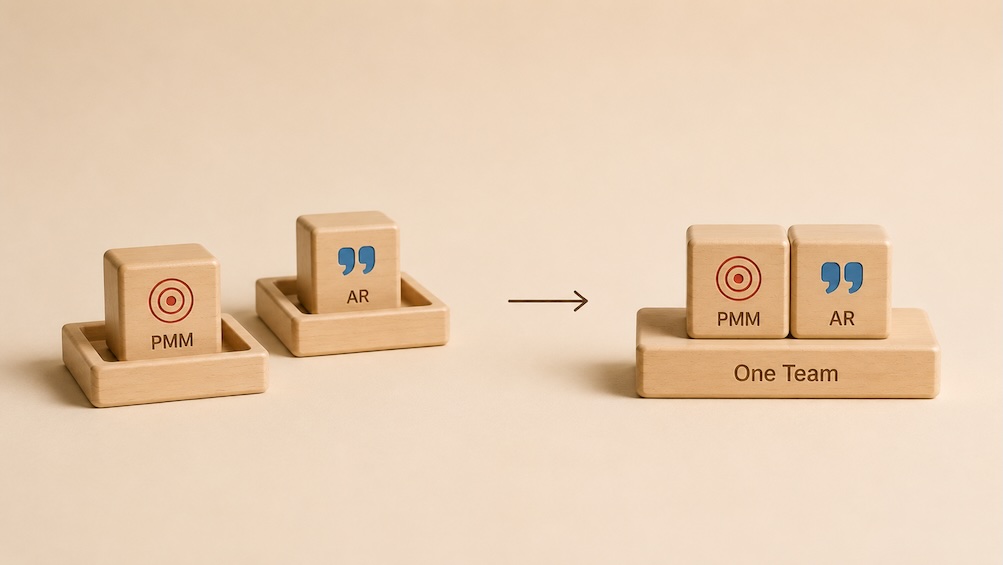
They don't have to share a reporting line, but they have to share a narrative. In most B2B software companies the strongest setup is Product Marketing (PMM) and Analyst Relations (AR) run as one team or as two functions with one owner and one agreed source of truth for the story. What fails, quietly and expensively, is the common default: two silos, two versions of the positioning, and no one accountable for keeping them the same. That default has always cost credibility. In the AI-search era it costs you the answer itself, because a buyer's first impression of your company is now assembled from your positioning and your analyst coverage at the same time, by a machine that doesn't care which department produced which sentence.
This guide is for founders, CMOs, and heads of marketing deciding how to structure the two functions that own your external story and for the PMM and AR leaders who have to make whatever structure they're handed actually work.
For twenty years I have been in the industry, the org-chart debate has mostly been about efficiency and turf. PMM owned the buyer-facing narrative with positioning, messaging, competitive intelligence, launches, and sales enablement. AR owned the influencer-facing narrative with the briefings, inquiries, and evaluations with the major analyst firms (Gartner, Forrester, IDC and their peers) whose written coverage shaped enterprise shortlists.
The two audiences were different, the rhythms were different, so the functions often lived in different corners of the org and coordinated when a launch or a Magic Quadrant cycle forced them to.
That separation made sense when analyst opinion and marketing positioning reached buyers through separate doors. It makes far less sense now. When a buyer, or a buyer's AI assistant, asks "who are the leading vendors for X and why," the answer is synthesized in one pass from everything the model can find: your website copy, your analyst placements, third-party write-ups, review sites, and press, blended into a single paragraph. The model does not know that your PMM team wrote the category definition and your AR team briefed the analyst. It reads both, notices when they agree, and notices when they don't. Consistency between the two has quietly become a ranking input, not just a nicety. That is the real reason the reporting-line question deserves a fresh answer.
It helps to be precise, because the overlap is where both the value and the friction live.
Product Marketing owns how the market should understand you: the category you claim, the problem you solve, the words for it, the proof, and the enablement that gets sales and the website telling the same story. PMM's clock runs on launches and pipeline.
Analyst Relations owns how the people who rate you understand you: it manages the relationships, briefings, and inquiries with analyst firms, feeds the evaluations that produce written coverage, and brings the analysts' view of the market back inside the company. AR's clock runs on relationship cycles and evaluation calendars, which are slower and less predictable than a launch.
The overlap is the narrative itself. Both functions are, in the end, making the same argument to different rooms: here is the category, here is where we sit in it, here is why. When one team changes that argument and the other doesn't hear about it, the company starts saying two things at once.
Put them together and three things get better.
- The narrative stays single. One owner means one category definition, one set of proof points, one competitive frame, briefed to analysts, shipped to the website, and handed to sales as the same story. The analyst hears the positioning the buyer will later read, and the buyer reads the framing the analyst already validated. That loop is the entire point of doing both functions well, and it closes far more reliably when the same leader is accountable for both ends of it.
- Intelligence flows both ways without a hand-off. AR sits in more candid market conversations than almost anyone in the company; analysts will say to an AR lead what a prospect never says to sales. When AR and PMM are one team, that intelligence lands directly in positioning and competitive work instead of getting lost in a quarterly sync. In the other direction, PMM's launch and win/loss insight sharpens what AR takes into briefings.
- You brief from strength. AR's job is easier when the underlying positioning is sharp, differentiated, and provable which is PMM's job. Structurally coupling them means analysts get briefed on a tighter story, and the evaluation reflects it.
One team is not automatically right, and pretending otherwise is how you build a structure that looks tidy and performs badly.
The skills genuinely differ. AR is relationship and influence work on a slow, diplomatic cadence; PMM is fast, launch-driven, cross-functional execution. A great PMM lead is not automatically a great AR lead, and asking one person to be both often means one discipline gets the leftovers. Combining the functions on the org chart does not combine the expertise; you still need real depth in each.
Cadence collides. When AR reports into a launch-driven PMM org, the slow, patient relationship work tends to lose every time it competes with this quarter's launch for attention. Analyst relationships neglected for two quarters are expensive to rebuild. If you merge, you have to protect AR's clock deliberately, or the merger becomes an absorption.
Independence has to be visible. AR's credibility with analysts rests partly on being a straight, reliable source of information, not a pure hype channel. If the combined team is run as an extension of campaign marketing, sophisticated analysts notice, and the relationship gets thinner. This is manageable as good AR is honest AR regardless of who it reports to but it's a real thing to guard.
Scale changes the math. At a certain size, both functions are big enough to need their own leadership, and forcing them under one manager creates a bottleneck rather than a bridge. Unity of narrative does not require unity of reporting line forever.
There is no universal right answer, but the variables that decide it are knowable. Work through these.
For most companies below roughly the growth-stage line, my honest recommendation is: one team, one owner, one narrative. Above it: keep them as distinct functions, but give one senior leader, usually the CMO or a VP of Product & Corporate Marketing, an explicit, non-optional mandate for narrative consistency across both.
Notice what all three share: a single, owned narrative. The models differ on reporting lines; they agree that exactly one version of the story exists and someone is accountable for it. That is the part that actually matters.
If you take one thing from this guide, take this: the org-chart question is secondary to the narrative-ownership question. Companies obsess over the boxes and lines and under-invest in the thing the boxes are supposed to produce, which is one coherent story told consistently to analysts, buyers, sales, and now the models that read all of it.
So regardless of which model you choose, do these. Name one accountable owner for the external narrative — a single person who can say "this is our category, this is our position, this is the proof," and whose sign-off both PMM and AR work from. Maintain one living messaging source of truth that both functions draw from and neither edits unilaterally. Put PMM and AR in the same room on a fixed rhythm, not just around launches, a standing cadence where analyst feedback flows into positioning and positioning updates flow into the next briefing. And close the loop deliberately: what analysts tell AR should visibly change what PMM ships, and what PMM ships should visibly change what AR briefs. Structure can make this easier or harder, but structure alone never does it. Discipline does.
Here is the stake that didn't exist a few years ago, and the reason this org-design question sits inside our Analyst Positioning pillar rather than an operations one.
When PMM and AR are aligned, an AI assistant asked about your category finds your positioning and your analyst coverage saying the same thing in compatible language. The model reads convergence as signal. It's more likely to place you in the category you claim, describe you in the words you chose, and cite the framing you built. You show up understood.
When they're misaligned, the model finds a website that calls you one thing, analyst coverage that files you under another, and sales collateral in a third dialect. It has no way to reconcile the three, so it hedges, blends, or defaults to whoever stated the category most clearly, which is often a competitor with a tighter, more consistent story. You don't get penalized with a warning. You just quietly don't show up in the answer, or show up described in someone else's terms. The cost of two silos used to be internal friction and a confused sales team. Now it's your visibility in the exact place buyers form their first impression.
This is why I treat PMM–AR alignment as a positioning problem, not just an HR one. The reporting line is a means. The end is a company that reads as one thing, understood, trusted, and chosen everywhere a buyer or a machine looks.
Should PMM and AR sit on one team? Usually yes below growth stage, and either way above it as long as one owner is accountable for a single narrative that analysts, buyers, sales, and AI systems all encounter as the same story. The reporting line is a tactic. Narrative consistency is the strategy, and in an AI-search world it's also the difference between being the company the machine describes accurately and the company it can't quite place.





Contact us to learn more about how we can help you accelerate your business success.

